|
• • • FRIDAY · AUG 28, 2026 • • •
|
Publisher Insider
Industry news, strategies, and exclusive case studies from the world leader in publisher monetization.
BROUGHT TO YOU BY

|
|
|
|
In today’s issue: what the path from zero to one million annual Discover clicks actually looks like when you build it as an operation, five stories from the last 24 hours, and the posts that owned the feed today.
|
|
Zero to one million clicks a year: what a real Discover operation looks like
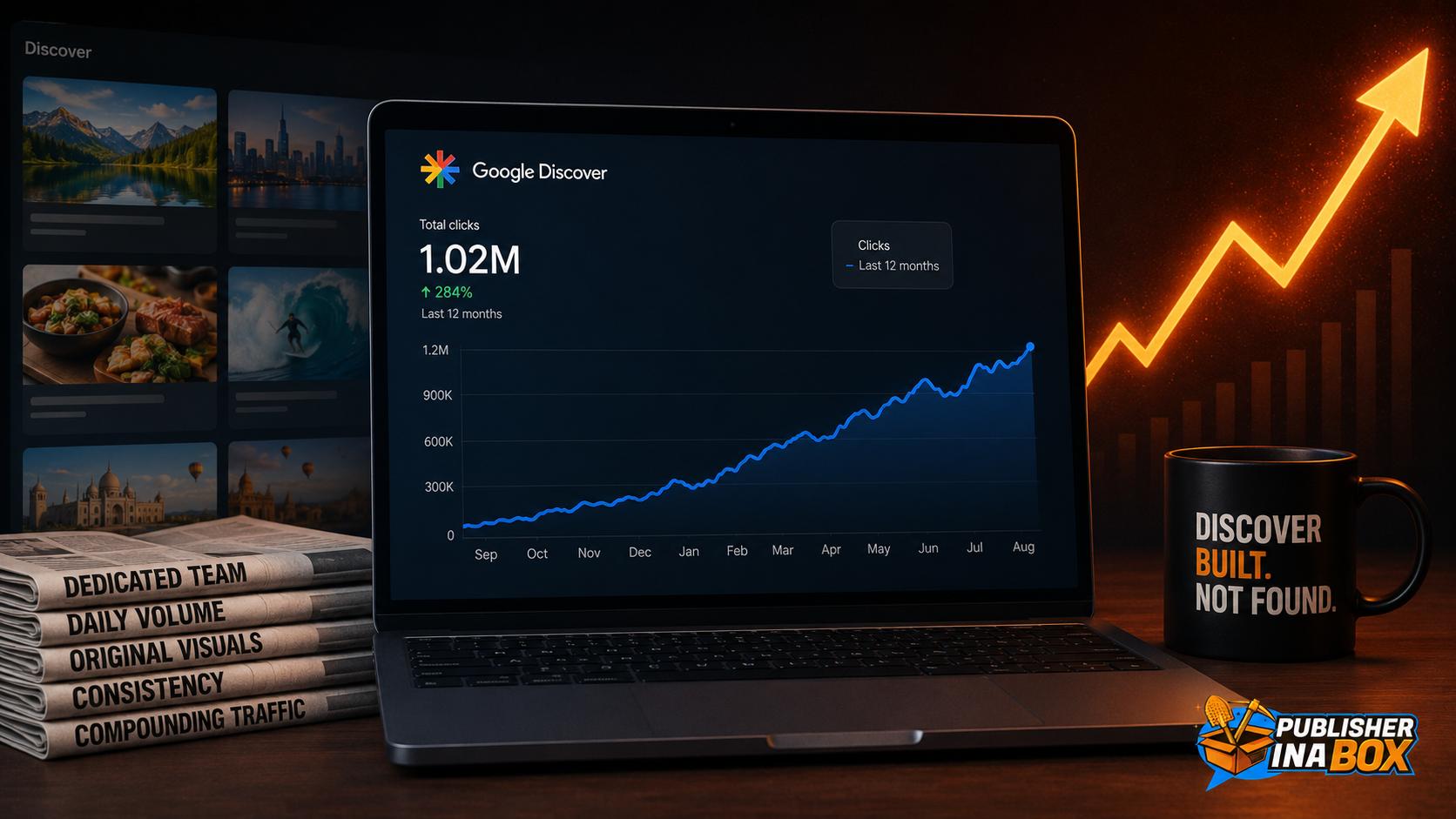
Google Discover is not a trick you bolt onto an existing SEO workflow. It is a distinct traffic-and-revenue department inside a diversified publishing business, and the publishers treating it that way are compounding into seven-figure annual click volumes.
|
|
Most publishers first encounter Discover as a pleasant surprise: a spike of traffic from a surface they never optimized for. The instinct is to chase that spike with tips and tricks. That is a mistake. The publishers building real value from Discover are the ones who built a dedicated operation around it. What follows is the trajectory of doing exactly that, from a standing start to roughly one million annual clicks off Discover alone.
Phase one: Recognize the asset class
Discover is not search. Search answers a query the user already typed; Discover surfaces content the user never asked for but is likely to want. That distinction changes the content mix, the cadence, the visuals, and the economics. The strategic move is to recognize that Discover belongs in the same tier as Facebook referral traffic, organic search, and syndication: a channel with its own compounding curve, and once you frame it that way, the investment case becomes clear.
Phase two: Stand up the operation
Building a Discover department means committing to a production system that runs every day. Volume is the mechanic: campaigns that publish at high daily frequency get picked up and stay picked up. That requires a separate content pipeline with its own brief format, its own writers or AI-assisted workflow, its own editorial calendar, and its own performance dashboard, producing short-form articles designed to load fast and earn a click-through, not long SEO pillars repurposed for a feed that rewards brevity. Every article needs original visual assets because the image is the Discover card: your own photography is the strongest signal, followed by properly sourced editorial imagery, then designer-created graphics, with AI-generated images at the bottom.
Phase three: Survive the early plateau and the algorithm cycles
Every Discover campaign hits a plateau where the clicks are modest and the economics do not yet justify the investment. This is where most publishers quit. The ones who push through understand two things. First, Discover rewards consistency over perfection: missing a couple of days does not collapse the campaign, but abandoning the cadence for weeks resets the algorithm's confidence in the site. Second, well-maintained campaigns survive algorithm updates. The August rollout came and went, and the operations with real daily consistency rode through it. Algorithm updates do not punish strong Discover operations. They expose weak ones.
Phase four: Compounding into the million-click range
This is where Discover starts behaving like an asset instead of a channel. A publisher running a mature operation is not chasing individual spikes anymore. The baseline rises, daily impressions become predictable enough to model revenue against, and at roughly one million clicks a year the traffic line sits alongside Facebook and organic search as a load-bearing part of the business, generating ad revenue, feeding the email list, and increasing the valuation of the property.
The point of this trajectory is not the number. It is the frame. Discover is a distinct department you build, staff, and run, not a box you check inside SEO. The publishers reaching one million annual clicks from this single surface are the ones who made that organizational decision early and stuck with it through the plateau.
|
|
THE FACEBOOK MONETIZATION SUITE
The automation engine, the profit playbook, and the asset valuation. Seven deliverables, one purchase.
Three core products and four bonus playbooks, each one personalized to your page and niche. The same publishing infrastructure behind 300M+ followers, calibrated to your operation and yours to keep. Facebook is also one of the biggest traffic drivers to your website when you run it as a real channel, and the Suite is built to help you do exactly that.
|
|
|
|
|
LATEST MARKET NEWS |
LAST 24 HOURS |
Moving the market right now.
5 stories that matter if you run pages.
| 1 |
|
Meta agreed to pay up to eighteen billion dollars to settle the landmark child safety lawsuit brought by 48 states, with sweeping platform changes including a default two-hour daily teen time limit, nighttime blocks between midnight and 6 AM, and muted notifications during school hours on both Facebook and Instagram. Settlement details →
|
| 2 |
|
Hours after the settlement, Meta published an open letter calling on TikTok and YouTube to adopt the same teen safety restrictions, arguing that safeguards on a single platform are insufficient because teens will simply migrate to competing apps. Meta open letter →
|
| 3 |
|
Five point three billion dollars of the settlement is contingent on TikTok and YouTube matching the safety measures and paying their own penalties, a structure that could reshape how every major social platform handles teen accounts going forward. Contingency structure →
|
| 4 |
|
Meta permanently removed the Messenger Stories ad placement as of August 27, part of the v26.0 API update that also strips placement exclusion controls from ad sets, pushing advertisers further toward Advantage+ placements. Messenger Stories gone →
|
| 5 |
|
Google Discover continues replacing individual publisher links with AI-generated summary cards that group multiple outlets under a single post, with data showing 77 percent of AI summary exits in the US go to YouTube rather than a publisher site. Discover AI summaries →
|
|
|
Top Performing Posts In The Last 24 Hours
|
POWERED BY
|
The hardest-hitting posts across NewsBomb’s 2,169-source index with the grade, reach, and format behind each one. Steal the format, not the post: run the same structure on your pages while the topic is still moving.
 |
|
#1 GRADE A+ VIRAL SCORE 100 · IMAGE POST
Fabrizio Romano hit 503,699 interactions with a Real Madrid transfer announcement
Takeaway: Breaking transfer news with a clear outcome statement and a single image card continues to dominate sports publishing on Facebook. The format is simple, the timing is everything.
503,699 INTERACTIONS · 11,282,858 EST. VIEWS · IMAGE POST · VIEW POST
|
|
 |
|
#2 GRADE A+ VIRAL SCORE 100 · IMAGE POST
Fabrizio Romano drove 269,610 interactions on a Julian Alvarez training absence
Takeaway: Speculation posts built around a developing storyline generate sustained engagement because the audience returns for updates. The unresolved narrative does the distribution work.
269,610 INTERACTIONS · 6,039,264 EST. VIEWS · IMAGE POST · VIEW POST
|
|
 |
|
#3 GRADE B VIRAL SCORE 94 · REELS
Donald J. Trump pulled 175,010 interactions on a short-form reel
Takeaway: Political figure pages generate massive reach from minimal-context reels because the audience is primed to engage on identity alone. The content is the person, not the production.
175,010 INTERACTIONS · 1,890,108 EST. VIEWS · REELS · VIEW POST
|
|
NewsBomb catches these before they peak.
|
|
|
|
|
Know a publisher who needs this? Forward it, or earn on every sale through the affiliate program
|
|
|
|
|
|
|
|
|
|
|
|
|
|
