|
What Digiday said
On the surface the story is about Meta’s new crawler terms, which would have let Meta scrape the sites of publishers with business accounts. Trade groups pushed back hard. The Guardian’s policy director said some publishers might leave Meta’s platforms altogether.
Then the article turns on itself. When Digiday asked the people who actually run audience at these publishers, none of them were ready to leave. Facebook no longer sends them meaningful traffic, but they still need it for reach, branded content, paid media and community. One of them put it simply: "Meta Zero is already here." Another said Meta holds them hostage.
So the real argument underneath the piece is that Facebook has stopped being a traffic channel for publishers and turned into a brand channel. You stay for awareness and you get your clicks somewhere else. Digiday treats that as settled, and so do the people they interviewed.
There’s a lot in there we agree with. Facebook is more than referral clicks, and any publisher who judges a page only by link traffic is missing half its value. The point about leverage is right too. Publishers can’t threaten to walk away from a platform they still depend on.
Where it goes wrong is who’s talking. Every voice in the piece is a large news organization. Their experience is real, but it’s one kind of publisher, and the conclusion gets applied to everyone.
They also only count one kind of money. Everyone in the piece is measuring referral traffic. Nobody mentions that Facebook now pays pages directly through Content Monetization.
Our take
What we see, across the publishers we work with and the pages we follow every day, is a different picture. Facebook traffic hasn’t gone away. It’s concentrated. A small percentage of publishers take the majority of it, and the rest share whatever’s left. When a big newsroom says Facebook sends them nothing, they’re describing which side of that line they’re on, not the platform as a whole.
A lot of them ended up there by choice. When reach dropped, they moved budget and people to search, newsletters and video, which was a reasonable call at the time. The pages that were left got recycled headlines and a link in the comments. Facebook showed that content to fewer people, the traffic dropped again, and the decision looked smart in hindsight. After a few rounds of that, "Facebook doesn’t send traffic" becomes something the whole team believes.
The publishers in the small group made the opposite call. They kept treating Facebook as a distribution business. In practice that looks pretty unglamorous. They pick a niche and stay in it. They post far more often than a newsroom would be comfortable with. Someone owns the numbers for every page and looks at them weekly, and pages that don’t earn get cut or rebuilt. None of this needs a big brand or a big team. Some of the strongest pages we track are run by a handful of people.
What most people miss is that Facebook money isn’t only traffic anymore. Publishers used to earn from Facebook by sending readers to their sites and running ads there. Now Facebook pays pages directly through Content Monetization, and it’s paying like crazy. So publishers are still earning on Facebook. They’re just earning in a different way, and anyone who only looks at referral clicks never sees it.
That’s also why a story like Digiday’s is good news if you’re a smaller publisher. Every big newsroom that writes Facebook off leaves more room in the feed for the pages still doing the work. Their share went to someone, and it went to the publishers who kept showing up.
You don’t need to be a household name to be in that small percent. You need to run your pages like they’re supposed to make money.
A partner of ours
This one is an established publisher in the home and lifestyle space. One website, 16 Facebook pages, with followings from about 15K up to about 900K.
When they came to us, the pages were clean and compliant and going nowhere. They ran on recycled schedules and link-in-comment posts. The biggest pages had the followers and earned very little from them.
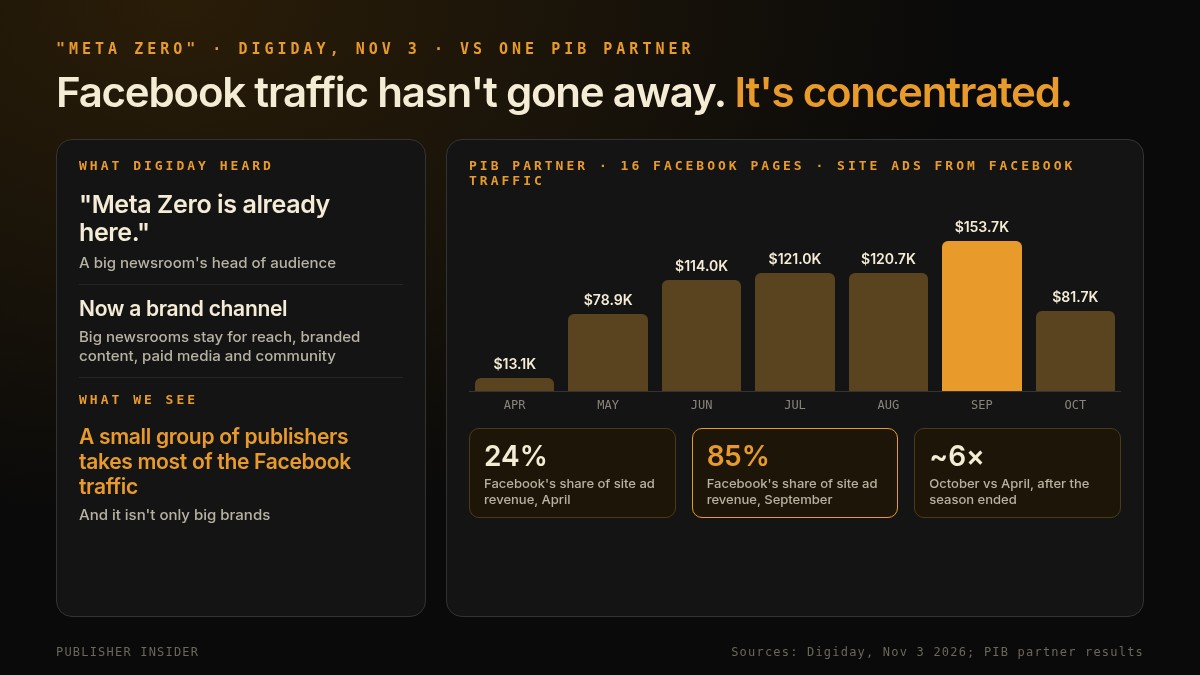
We took over day-to-day distribution on April 3. That month, Facebook traffic earned the site $13.1K in ad revenue, about a quarter of what the site made.
The recycled schedules went. Fresh posts on the niche replaced them, a lot more per day, timed to what their readers cared about that month. Every page got its own tracking, so we could see what each one actually earned.
By September the same 16 pages brought in $153.7K in site ad revenue, and Facebook was 85% of what the site made.
October came in at $81.7K. The season ended, and we stopped investing in pages that couldn’t cover their costs. It was still about six times April.
Follower counts barely mattered. The biggest page finished September 12th of the 16 on earnings. A mid-size page that made under $500 in July was fourth by September.
This publisher didn’t do anything exotic. They did what the small group does, and Facebook went from a side channel to most of their business in six months.
|