Industry news, strategies, and exclusive case studies from the team managing 300M+ followers. We cover Facebook monetization, Google Discover, content syndication, and everything publishers need to grow revenue.
Share
$60,397 to $165,909 in 30 days. Here are the receipts.
Published 1 day ago • 9 min read
JULY 16, 2026
PUBLISHER INSIDER
One operator turned two plateaued websites into a 694% Facebook revenue jump in 30 days, going from $60,397 to $165,909 with the dashboards to back it. That story anchors this issue.
We also get into why a 90-day monetization freeze only takes down the publishers who built one thing, plus what the latest moves in GEO, Search Console social tracking, and Meta's AI paywall mean for how you build.
The Publisher Insider newsletter is brought to you by Publisher in a Box-- the best of the best in the world at publisher monetization.
🧠 INSIDER ANALYSIS OF THE WEEK - PART 1
They told you Facebook won't send traffic to your website. One operator just grew his Facebook website revenue 694 percent in 30 days. Here are the receipts.
Real dashboards, real revenue. This publisher turned Facebook into their main traffic engine.
The setup: two content sites in the same niche, both monetized with display ads, both stuck in the same place every content site gets stuck. Combined, they were doing $60,397 a month, almost all of it from Google and Pinterest. Solid. Plateaued. Going nowhere fast.
Then the operator flipped the model. Instead of treating his Facebook pages as the destination, he started using them as the engine, dropping links into posts and sending readers to the websites, where the ad revenue was his to keep.
Thirty days later:
Facebook revenue across the two sites went from $14,727 to $116,886. That is a 694 percent jump in one month.
Combined revenue went from $60,397 to $165,909, up 175 percent in 30 days.
On the smaller of the two sites, Facebook revenue multiplied almost 24 times over, from $1,587 to $37,966.
And it was not a spike. The next month held at $166,664, with the bigger site posting $142,696.79 on its own and Facebook driving 80 percent of it at $113,985. Across the two months after the flip, the pair of sites netted a combined $332,573.
The quality held while the volume exploded. The bigger site ran 1,766,092 pageviews and 54,286,005 ad impressions in a single month while RPM sat at $99.09. Mobile carried 76 percent of revenue, which tracks with how Facebook readers consume content. One article pulled $13,384.78 by itself.
He is not the only one. Just this week a certified financial planner published his own numbers: $42,035 in a single month from posting on Facebook. Different niche, same engine.
This is the model. The Facebook page feeds the website, the website monetizes the traffic through display ads, and that revenue funds everything that comes after, from content to list building to new pages. You are not just running a page. You are building a diversified publishing business, and Facebook is the fastest funding source from month one.
So what happens when that engine pauses? In Part 2, we pull the exact 90-day monetization freeze straight from Meta's own support assistant, and show why the only publishers who get hurt are the ones who built one thing.
🧠 THE $8K SYSTEM, PACKAGED FOR $499
Those dashboards are not a one-off win. They are what happens when a page finally runs on infrastructure instead of guesswork.
The Facebook Monetization Suite is that infrastructure: all seven deliverables we use to move a page from posting to paying, for $499. One publisher put in $8,000 through the full consulting engagement, made it back in three months, and now clears $8,000 to $10,000 a month.
A 90-Day Monetization Freeze Only Breaks the Publishers Who Built One Thing.
In Part 1, one operator turned two plateaued websites into $332,573 of revenue in 60 days by making Facebook the engine. Now for the other side of that coin: what happens when the engine pauses.
Here is what actually happens during a Facebook monetization suspension, pulled straight from Meta's own support assistant. An "Inauthentic Engagement" violation on a profile triggers a suspension of roughly 90 days. Your earnings are not deleted, they go on hold. You appeal by selecting "Disagree with decision" or "Request Review," which sends your account and the specific violation to a review team. Most reviews close within 72 hours, though complex cases take longer. If the appeal succeeds, eligibility is restored and held payouts release on the next scheduled date. If the suspension runs its full course clean, restoration is typically automatic after the 90 days, provided you followed the Partner Monetization Policies throughout. If the violation is confirmed and unresolved after that window, Meta may permanently withhold the unpaid earnings.
That said, the process is not always as smooth as those timelines suggest. Enforcement right now leans heavily on AI review, and legitimate operators sometimes get caught in the net. Appeals do not always resolve within 72 hours, and some sit longer. This is not a reason to distrust the platform. It is the current reality of the review process, and it is exactly why your revenue base needs to be wider than a single login.
An operator with only a Facebook page has one answer while a payout sits on hold: nothing. Revenue flatlines until a review team gets to the case. An operator running a real publishing business has a different answer. The website still pulls display revenue through Google search and Pinterest, the newsletter still goes out, and other pages still post. The biggest engine is in review, and the business keeps moving because it was never one login away from zero.
This is Part 1 read backwards. There, Facebook multiplied two websites into six figures a month. Here, those same websites are what carry you when Facebook pauses.
Facebook stays the center of this. It is the fastest money a new publisher can make and the engine that funds everything else from month one. The streams around it do not replace it. They protect it, and they protect you. You are building a publishing business, not just running a page.
Which leaves one problem. When Facebook freezes your money, it almost never tells you why. The same generic error can trace back to a dozen different causes, and the real trigger often hides on a screen you are not even looking at. Working out what hit you, what to do next, and what to say when you reach Facebook is the hardest part of this to do alone.
The Meta Payout Troubleshooter is a live agent we use on real frozen accounts, packaged so you can run it yourself on your computer. It walks you through finding what actually triggered the restriction, tells you what Meta's own process says happens next, and gives you exactly what to say when you open your support case. No guesswork, no forum rumors, no $500 consultant.
It is $29.99. If your money is on hold right now, this is the first 30 minutes of getting it back.
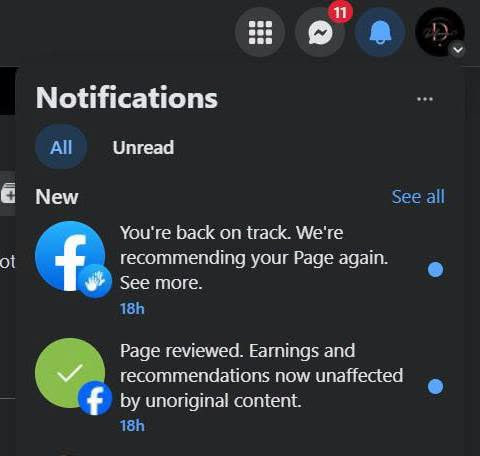
Another publisher getting his monetization and recommendation back.
Restrictions aren't the end.
Don't give up. https://twitter.com/publisherinabox/status/2073854048428605459
→ Google's New Search Console Social Tracking Is Not a Gift. It Is a Distraction Google recently updated Search Console to let brands track how their social media and video posts perform in search results. Most marketers see this as a helpful addition. The reality is more calculated. According to Search Engine Journal, this update serves two purposes. First, it masks the traffic loss caused by AI Overviews answering queries directly on the search page. If your website traffic drops, Google can point to your social media impressions in search results and argue you are still getting visibility, even without actual clicks. Google is redefining what "success" means so the decline looks less severe. Second, when you verify your social accounts inside Search Console, you hand Google a clean identity map connecting your website, your X profile, your TikTok, and everything else to one entity. Google uses this verified data to train its AI models on who the real authorities are and to separate legitimate publishers from synthetic spam sites. For publishers, the takeaway is straightforward. Track these new metrics if they are useful, but do not let them replace the numbers that matter: clicks, revenue, and audience you own. Build your newsletter. Build your website traffic through Facebook and Google Discover. Treat every platform as a distribution channel feeding assets you control.
→ Instagram is reportedly moving toward charging users for access to its AI features The details matter less than the signal: Meta is testing willingness to pay for AI tools inside its own apps. If that model works on Instagram, expect it to migrate across the Meta ecosystem, including Facebook. For Facebook publishers, this is worth watching for two reasons. First, if Meta begins gating advanced AI features behind a paywall, free-tier creators could lose access to tools that help with content creation, editing, or discovery. Publishers who already treat their pages as real businesses will adapt faster than hobbyists who panic at every platform change. Second, this confirms Meta views AI as a revenue line, not just an internal cost center. That changes the incentive structure. Features that drive subscriptions will get prioritized. Features that only help free users may get deprioritized over time. The practical move right now is not to react, it is to prepare. Build your publishing operation so it does not depend on any single tool or feature staying free. That means diversifying your content formats, understanding what performs organically without AI assistance, and treating every new Meta feature as a bonus rather than a crutch. Facebook remains the most stable monetization platform for publishers. But stability comes from how you build, not from assuming the tools never change.
→ Google Says Long A/B Tests Won't Trigger a Penalty. Their Own Docs Say Otherwise Google's John Mueller told a site owner on Bluesky that running A/B tests for 6 to 12 months should not cause a penalty or demotion. He said Google would simply index whichever version it crawls, and varying content is common across the web. The problem: Google's own A/B testing documentation explicitly warns that running an experiment for an "unnecessarily long time" could be interpreted as an attempt to deceive search engines, with action taken accordingly. That warning gets stronger when one content variant is served to a large percentage of users. For publishers, this matters if you are testing redesigned article layouts, new ad placements, or different content structures on your site. Mueller's answer focused narrowly on indexing, not on the broader risk the documentation describes. If Googlebot crawls different HTML structures on rapid rotation, you also lose the ability to reliably debug ranking and indexing issues. The practical move: run your tests, collect statistically significant data, then commit to the winning version. Use rel=canonical on all variants and 302 redirects if you are splitting traffic across URLs. Do not let a test drift for months just because one Googler said there is no penalty. The official docs still carry that warning, and Google has not updated them.
→ Specific beats insightful: what AI citation data means for your GEO strategy A Bluesky user named Dan posted that long, highly specific articles he wrote last year are now being cited and condensed by Claude AI, sometimes with explicit references to his posts. His takeaway: if you write about a specific enough topic and people link to it, you have a real chance at influencing LLM output within a year. Others confirmed the pattern. One commenter noted their content got pulled into AI responses within six months, even when it was not particularly insightful, just specific. Google's John Mueller reposted the thread with a simple endorsement: "Make more insightful & useful stuff." For publishers building a GEO strategy alongside Facebook and Google Discover, this is a practical signal. Keyword-driven SEO is outdated for LLM discovery. What matters now is topical focus. Articles that stay tightly on a single subject, cut the tangents, and go deep are the ones AI models treat as authoritative sources. The action item: when planning website content, pick narrower topics and write the most thorough, focused piece available on that subject. Specificity is what gets you cited in AI answers, which is the foundation of GEO.
🧭 The AI Answer Land Grab
Your category's AI answer slot is still open, and every day it stays open is a day a competitor could take it instead.
The GEO Authority System gets your pages structured so AI engines can read them, cite them, and pull answers straight from your copy, for $499.
Move first. The publishers cited early keep that spot for years.
P.S. NewsBomb just opened to beta subscribers, and this pricing won't last. Lock it in now at $29.99/mo for your first 6 months instead of $99. It renews at the regular $99/mo after that, and you can cancel anytime before then.
The #1 newsletter for publishers and news organizations. Free, twice a week.
Industry news, strategies, and exclusive case studies from the team managing 300M+ followers. We cover Facebook monetization, Google Discover, content syndication, and everything publishers need to grow revenue.
JULY 14, 2026 PUBLISHER INSIDER Hey there, Earlier this year, millions of advertisers watched their Facebook numbers fall 15 to 40% overnight. Almost none of them lost a single sale. The ones who understood stayed calm and kept building. The ones who panicked gutted campaigns that were working, and turned a fake problem into a real one. That gap, between a bad week and a bad strategy, is the most expensive one in this business. Everything below is about landing on the right side of it: your...
JULY 9, 2026 PUBLISHER INSIDER There are two AI stories running right now, and telling them apart is worth money. This week's briefing takes both, in two parts: the AI hype that even Meta cannot make work, and the AI shift that is quietly deciding who gets found in your niche. Plus two moves out of Meta worth a glance. If you read one thing this week, make it the difference between the two. The Publisher Insider newsletter is brought to you by Publisher in a Box-- the best of the best in the...
JULY 7, 2026 PUBLISHER INSIDER Owning a page and running a publishing business are two different games. This week's briefing lays out the second one in three parts: the pillar, the playbook that works at any size, and the AI search territory that is open now and will not stay that way. Plus Facebook testing public view counts on posts, and what that changes for pages already stacking reach. Whatever the market is doing this season, hot or cooling, read this week's briefing closely. The...